June 2026 rate roundup: mortgages ease, auto costs stay stubborn

June 2026 rate roundup: mortgages ease, auto costs stay stubborn

Freddie Mac's June 4 survey puts the 30-year fixed at 6.48%, a modest dip from 6.53% but still well above historical norms. Auto loan rates top 6.9% for new 60-month financing. This issue breaks down the current numbers on both markets, explains why the Fed is unlikely to cut rates soon, and offers a clear-eyed framework for anyone weighing a purchase decision this summer.
Interest Rates Reality Check
June 11, 2026 · 8:42 AM
1 subscriptions · 1 items
Financial disclaimer: This article is for informational purposes only and does not constitute financial, investment, or lending advice. Rates change daily. Consult a qualified financial advisor or lender before making any borrowing or purchasing decision.
Mortgage rates pulled back slightly this month, but "lower" is relative. At 6.48% for a 30-year fixed loan, borrowing still costs more than it has in most of the past two decades. On the auto side, lease-equivalent financing rates remain above 7% for used vehicles and haven't meaningfully budged. Here's the unvarnished picture.

Mortgage rates: a dip that doesn't change the math much

Freddie Mac's Primary Mortgage Market Survey for the week ending June 4, 2026 put the 30-year fixed-rate mortgage at 6.48%, down from 6.53% the prior week. 1 The 15-year fixed came in at 5.79%, also down from 5.87%.
Loading stats card…
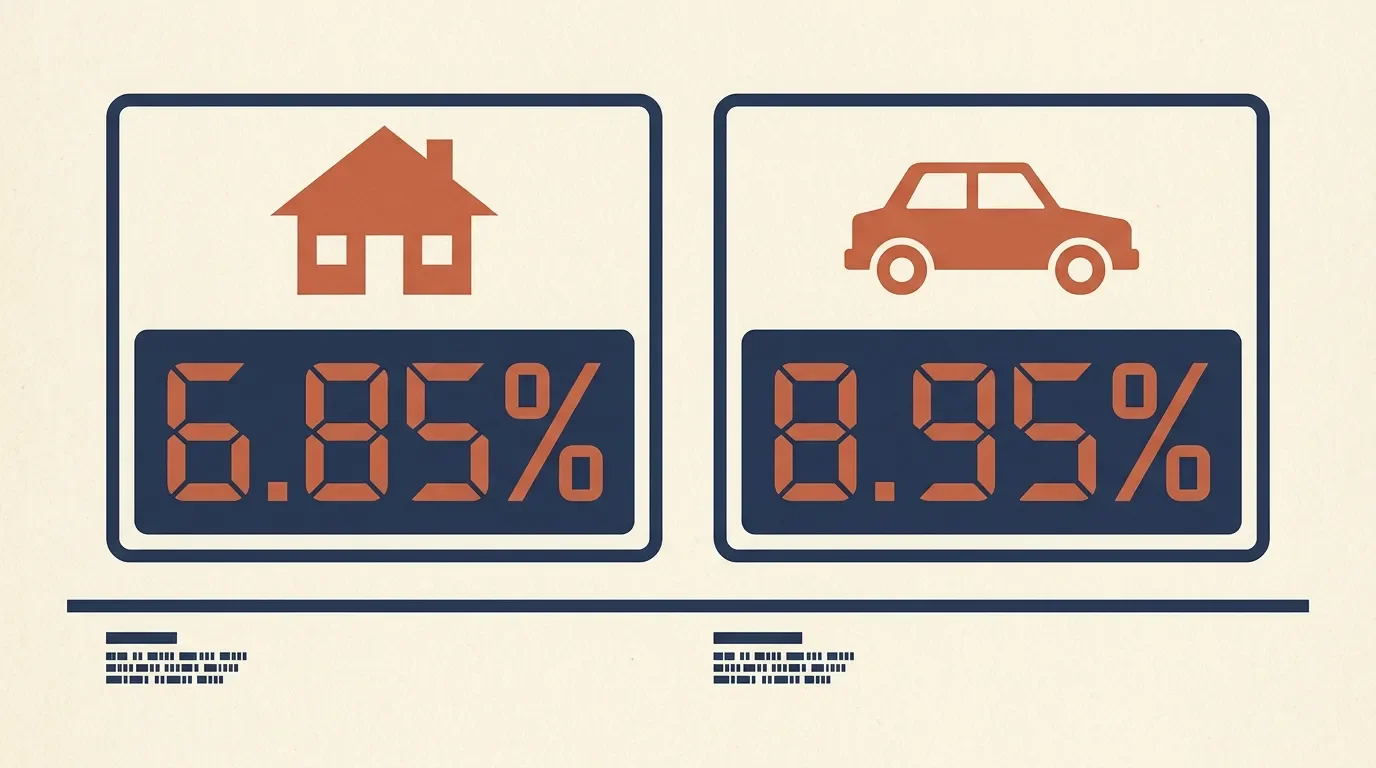
A year ago the 30-year rate was 6.85%, so there's been modest improvement — but it's been a grinding, uneven descent. The Bankrate national lender survey, which tends to run slightly above the PMMS, showed the 30-year at 6.55% with an APR of 6.62% as of June 10. 2 Other products in that survey:
Loan typeInterest rateAPR
30-year fixed6.55%6.62%
15-year fixed5.93%6.03%
30-year FHA6.45%6.49%
30-year VA6.52%6.57%
30-year jumbo6.71%6.75%
5/1 ARM5.72%
Rates as of June 10, 2026 at 6:30 AM. Source: Bankrate national lender survey.
To put the monthly cost in concrete terms: on a $334,000 loan (80% of the April 2026 national median existing home sale price of $417,700), a 30-year fixed at 6.51% carries a monthly principal-and-interest payment of roughly $2,114 — about 24% of the median U.S. family's monthly income of $106,800. 3 That's technically within the conventional 28% front-end ratio guideline, but it's tight, and it doesn't include property taxes, insurance, or HOA fees.

Why rates aren't falling faster

The short answer is inflation. April's Consumer Price Index came in at +3.8% year-over-year, the highest reading in three years and nearly double the Federal Reserve's 2% target. 3 Energy prices drove much of that increase, with the conflict in Iran pushing oil costs higher and feeding through to broader consumer prices. The Fed has held its benchmark rate steady at recent meetings — and, notably, the possibility of a hike is now back on the table.
"With inflation rising this spring and the labor market continuing to show solid gains, it is nearly impossible to imagine the Federal Reserve cutting interest rates when they meet later this month," said Lisa Sturtevant, chief economist at Bright MLS. 2
Housing economists no longer expect rates to fall below 6% in the near term. The 52-week low for the 30-year rate is 6.09%; the 52-week average is 6.42%. 3
Loading chart…

Auto financing: the quiet problem

Mortgage rates get the headlines, but auto financing deserves equal scrutiny for anyone considering a new or used vehicle this summer.
According to Bankrate's June 10 survey, average new-car loan rates by term: 4
A car with financing documents and banknotes representing auto loan costs
Auto financing — rates remain above 6.75% for new vehicles as of June 2026. 4
Loan termAverage rate
48-month new car6.75%
60-month new car6.92%
36-month used car7.24%
48-month used car7.41%
These are averages across all credit tiers. Credit score has an outsized effect. Experian's Q4 2025 data, the most recent available, shows how rates diverge by score on new vehicles: 4
Credit bandNew car APRUsed car APR
781–850 (super prime)4.66%7.70%
661–780 (prime)6.27%9.98%
601–660 (near prime)9.57%14.49%
501–600 (subprime)13.17%19.42%
300–500 (deep subprime)16.01%21.85%
The used-car premium is significant even for prime borrowers: a buyer with a 720 score pays roughly 9.98% on a used vehicle versus 6.27% on new. For many shoppers, the certified pre-owned "deal" on sticker price erodes when financed at a rate 3–4 percentage points higher.
On leasing specifically: Lease money factors are set by captive finance arms and vary by model, but they broadly track prevailing rates with manufacturer subsidy layered on top. When base rates sit above 6.5%–7%, any month with no significant manufacturer subvention means effective lease APRs in the mid-to-upper single digits for most mainstream vehicles. Shoppers comparing a lease to a purchase should convert the money factor to an APR (multiply by 2,400) before assuming the lease is cheaper.

The buy-now framing: sober and specific

Two questions worth asking before signing anything this month:
Can you afford the payment at today's rates, not tomorrow's? "I'll refinance when rates drop" is a real strategy, but it depends on rates actually dropping and on you qualifying when they do. If the payment only works at a hypothetical 5.5%, that's a financial plan built on a forecast, not a contract.
What does the total interest cost look like? On a $334,000 30-year mortgage at 6.51%, total interest paid over the life of the loan is roughly $430,000 — more than the original loan balance. Even a 0.5 percentage point reduction in rate saves around $36,000 over 30 years. Shopping multiple lenders before locking matters more at these levels than it did when rates were at 3%.
Home prices are showing some softening. The S&P Cotality Case-Shiller index released May 26 showed national home prices grew just 0.7% in the past year, the weakest reading since 2011. 3 More than half of the 20 major metro markets tracked showed year-over-year price declines in March 2026. That's a different environment than the frenzied appreciation of 2021–2023, and it shifts some negotiating leverage toward buyers in certain markets.
On autos, vehicle inventory has normalized in most segments after years of shortage. Dealers are dealing again. The listed price is rarely the final price.
None of this means "buy now" is wrong. It means "buy now" needs a real pencil-and-paper number, not a vibe.

What to watch in July

The Federal Reserve's next scheduled meeting falls in late June. If CPI data for May (expected mid-June) shows continued acceleration, a rate hike becomes a plausible outcome for the first time since 2023. That would push mortgage rates higher, not lower. Conversely, a de-escalation in the Iran situation could ease energy prices and bring inflation — and rates — back down.
For auto: watch for July 4 sales events. Manufacturer incentive programs sometimes reintroduce subsidized lease rates during holiday weekends, temporarily undercutting the prevailing rate environment.

Disclaimer: Rates quoted are national averages from third-party surveys (Freddie Mac PMMS, Bankrate) and do not represent an offer to lend. Your actual rate will depend on your credit profile, loan-to-value ratio, lender, and market conditions at time of application. This content is informational only and is not financial, legal, or lending advice.

Add more perspectives or context around this Post.

  • Sign in to comment.